Soliman Pasha al-Faransawi
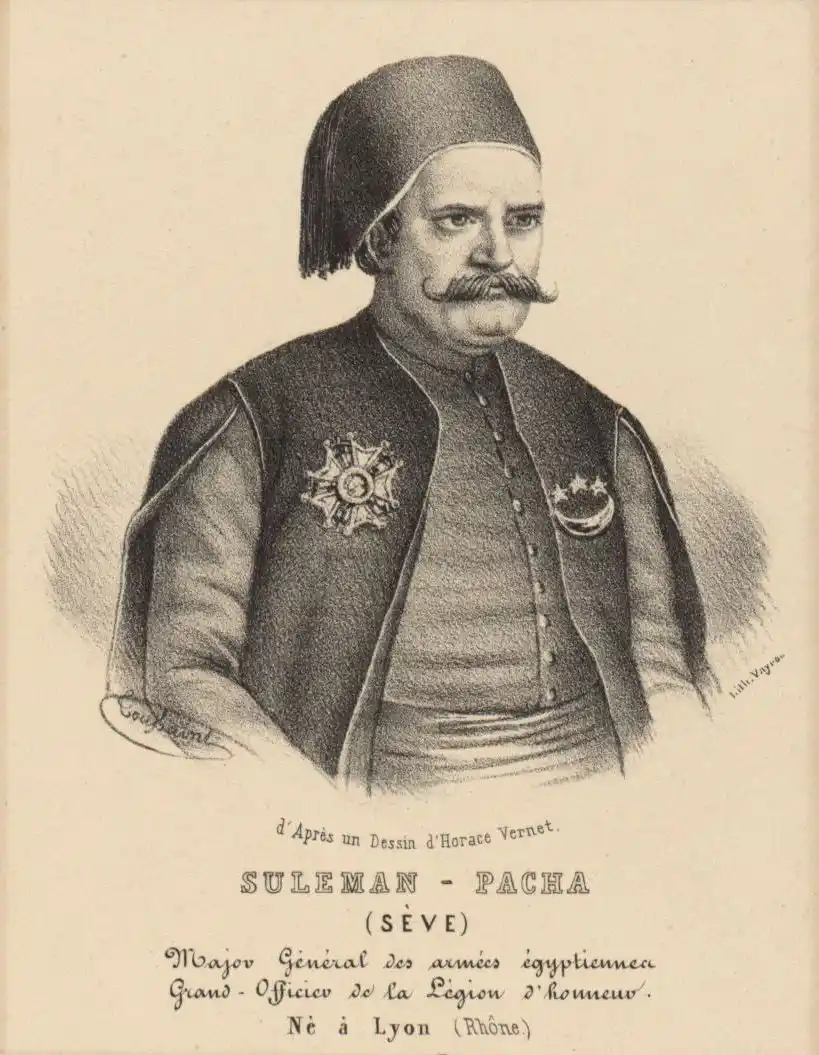
Soliman Pasha “the Frenchman” was an official of the Ottoman Empire. During the Egyptian intervention to suppress the Greek Revolution (1824–1827), he served as a senior commander of the expeditionary force and as deputy to Ibrahim Pasha of Egypt.
Soliman Pasha al‑Faransawi was born in Lyon, France, in 1788 as Joseph Anthelme Sève and had served in Napoleon’s Grande Armée before seeking refuge in Egypt. He converted to Islam in 1815 and swore an oath of loyalty to Muhammad Ali of Egypt.
Soliman Pasha “the Frenchman” became head of the artillery of the Egyptian army and took a particular interest in the training of soldiers, establishing camps where modern military tactics were taught. During the Egyptian intervention to suppress the Greek Revolution (1824–1827), he served as a senior commander of the expeditionary force. In February 1825, as deputy to Ibrahim Pasha in the Peloponnese, he directed the military operations for the capture of Methoni. He also took part in the operations leading to the capture of Tripolitsa and followed a scorched‑earth policy, destroying settlements and crops and capturing thousands of Greek civilians.
During Ibrahim Pasha’s siege of Missolonghi, Soliman Pasha was appointed commander of the occupied territories of the Peloponnese. After the Battle of Navarino (1827), he was responsible for overseeing the evacuation of Egyptian troops from Greek soil. He later distinguished himself in the Egyptian–Syrian wars and was honored as a prominent figure in Egyptian military history.
He married one of the daughters of Nikolaos Tabakopoulos, who had been taken captive after her father’s death in 1825. Soliman Pasha “the Frenchman” and Maria Myriam Hanım had four children and lived in Cairo, Egypt. Soliman Pasha died in 1860. His great‑granddaughter, Nazli, became a member of the Egyptian royal family through her marriage to King Fuad I.