
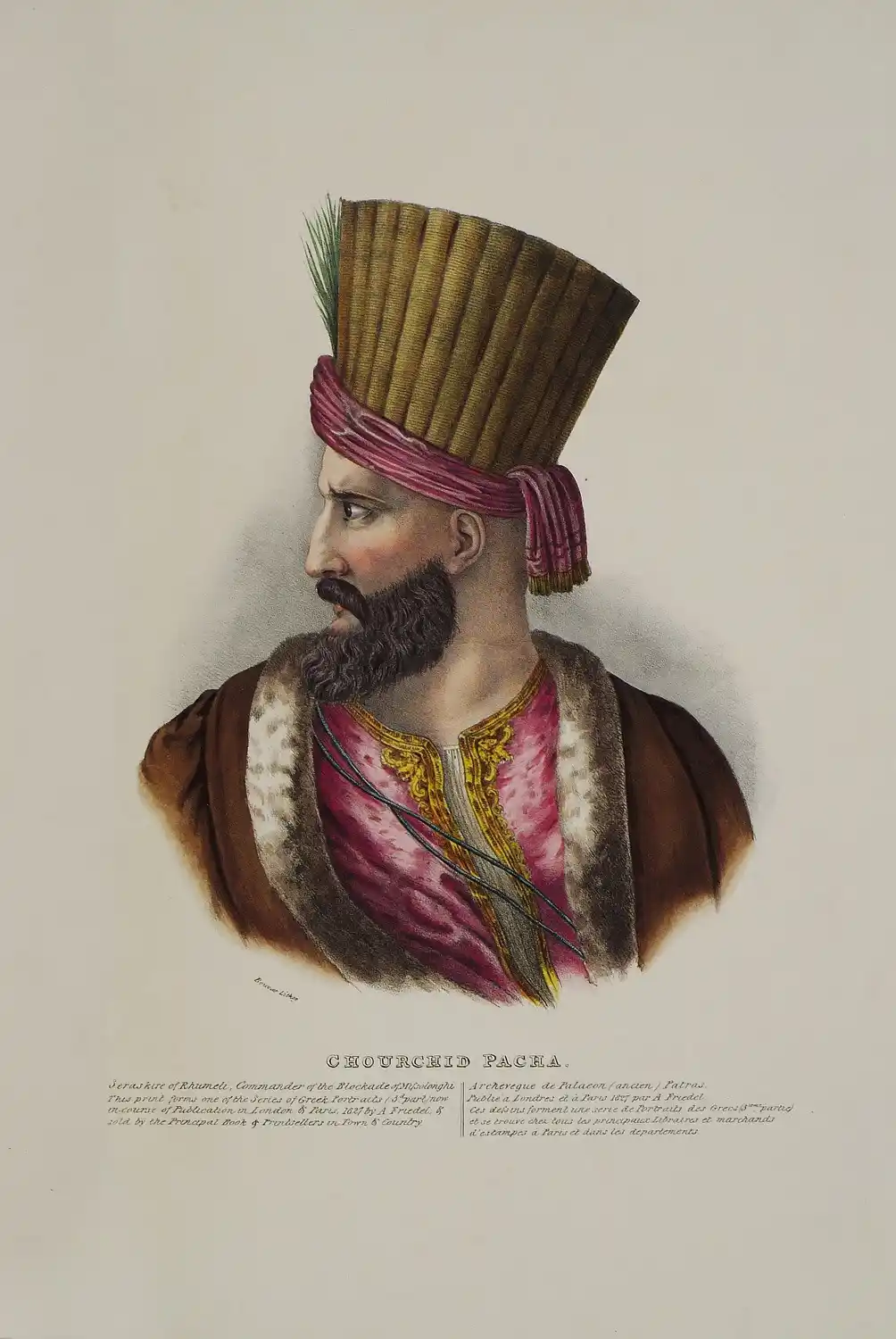
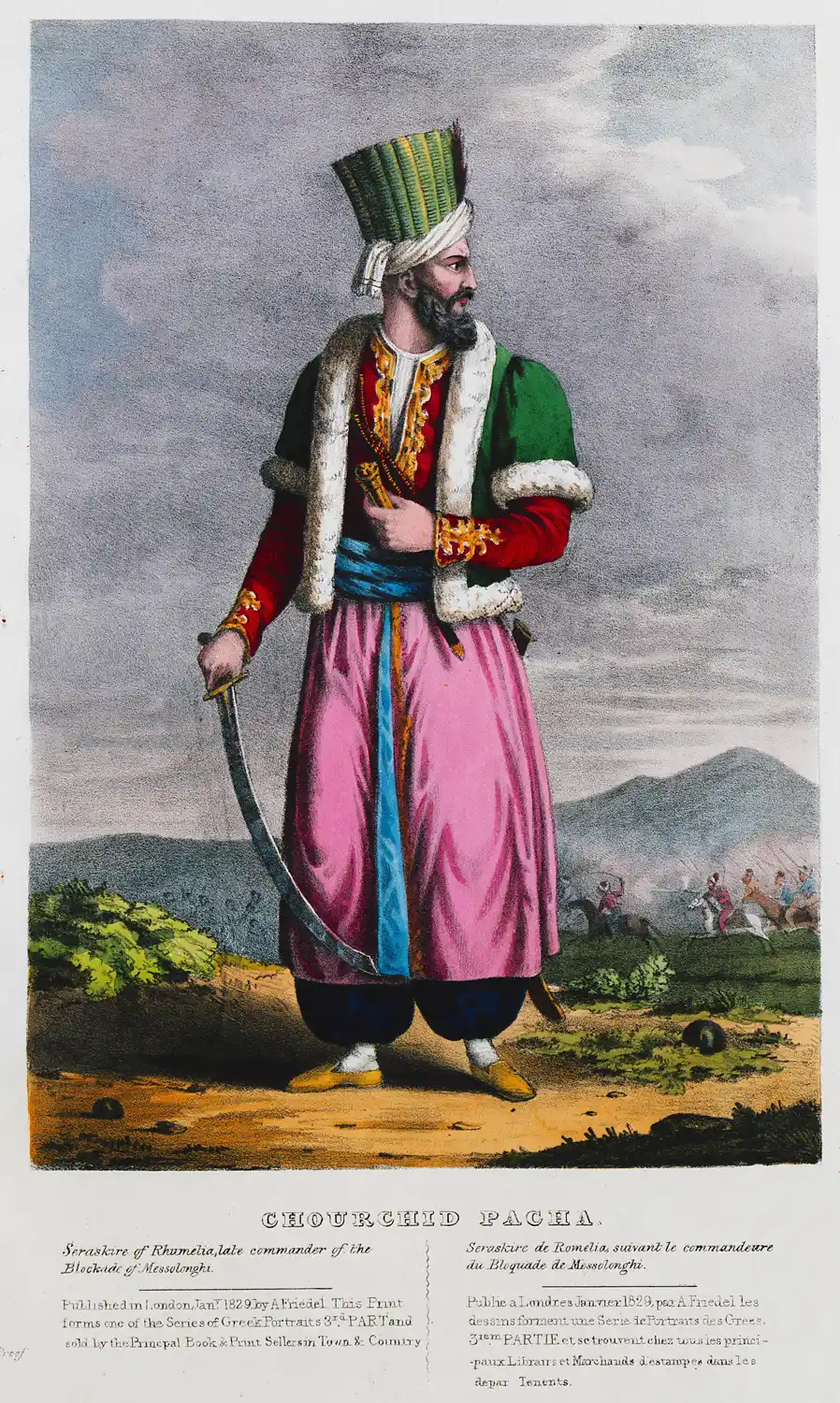
Hurşid Ahmed Pasha
Khurshid Pasha served as the Mora Valesi (Governor‑General) of the Peloponnese at the outbreak of the Revolution. He was a high‑ranking official, a military commander, and Grand Vizier of the Ottoman Empire.
Khurshid Pasha was born in Christian Georgia in the Caucasus. At a young age he converted to Islam and entered the corps of the Janissaries. In 1803, during the reign of Sultan Selim III, he rose to the rank of pasha. He served as Vali (Governor‑General) of Rumeli (1806, 1814) and held the satrapy of Aleppo in Syria (1808 -1815). In March 1809 he was entrusted with suppressing the Serbian uprising, continuing military operations in the region until 1813. For this success, upon his return to Constantinople he was appointed Grand Vizier—effectively prime minister—of the Ottoman Empire. In 1815 he once again suppressed a renewed Serbian revolt under the leadership of Miloš Obrenović.
In November 1820 he was appointed Mora Valesi, the supreme governor of the Peloponnese, with his seat in Tripolitsa. At the same time, he led as serasker (military commander) the campaign against Ali Pasha of Ioannina. In 1821, while in Epirus, he ordered Omer Vryonis and Kiose Mehmet to march against the Greek insurgents in Eastern Central Greece, and dispatched Kehayabey Mustafa with 3,000 men toward Tripolitsa to safeguard his property and harem.
After the capture of Ali Pasha in January 1822, Khurshid Pasha turned his attention to the revolted Peloponnese. By then, however, the Sultan’s confidence in him had been shaken. He was therefore replaced by Mahmud Pasha, known as Dramali, as commander of the campaign in the Morea. Khurshid Pasha ended his life by taking poison in late November 1822, while in Larissa.